

Hey there! As a supplier of Stretch Lining, I often get asked this question: "Is stretch lining water-resistant?" Well, let's dive right into it and break it down.
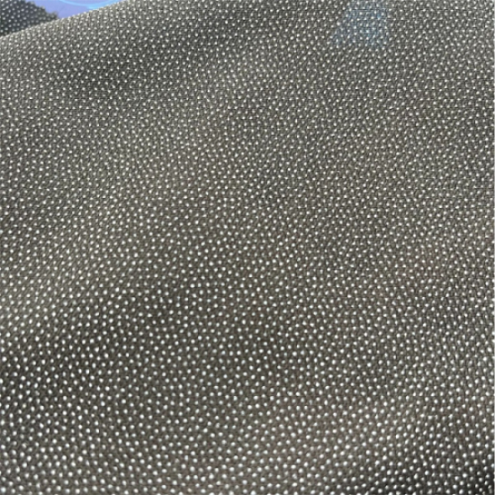
First off, what exactly is stretch lining? Stretch lining, like the ones you can check out on our Stretch Lining page, is a type of fabric that's used in clothing and other textile applications. It has the ability to stretch and recover its shape, which makes it super useful for garments that need to move with your body. You know, like those form-fitting dresses or the inner lining of a pair of stretchy pants.
Now, when it comes to water resistance, it's not as straightforward as you might think. Water resistance is all about how well a fabric can keep water from passing through it. There are different levels of water resistance, ranging from just a little bit of protection to being completely waterproof.
Let's start by looking at the basic properties of stretch lining. Most stretch linings are made from a blend of fibers, such as polyester, nylon, and spandex. These fibers have different characteristics when it comes to water. Polyester and nylon are synthetic fibers that are relatively hydrophobic, which means they don't absorb water easily. On the other hand, spandex is more hydrophilic and can absorb some moisture.
The construction of the stretch lining also plays a big role. A tightly woven stretch lining, like the Woven Waterjet Interlining, is generally more water-resistant than a loosely woven one. The tight weave creates a barrier that makes it harder for water to penetrate the fabric.
But here's the thing: just because a stretch lining has some hydrophobic fibers and a tight weave doesn't necessarily mean it's water-resistant. There are other factors to consider, like the finish of the fabric. Some stretch linings are treated with special water-repellent finishes. These finishes can make the fabric more resistant to water by causing water to bead up and roll off the surface.

For example, our Stretch Material White Lining Fabric can be treated with a water-repellent finish during the manufacturing process. This treatment adds an extra layer of protection against water. However, it's important to note that these finishes can wear off over time, especially with repeated washing and use.
Another factor is the porosity of the fabric. Even a tightly woven stretch lining has tiny pores between the fibers. If the water pressure is high enough, or if the fabric is submerged in water for a long time, water can seep through these pores. So, while a stretch lining might be able to resist a light rain shower, it might not hold up well if you're out in a downpour or if you're sweating a lot.
In some cases, stretch lining is used in combination with other waterproof or water-resistant materials. For instance, in a waterproof jacket, the stretch lining might be used on the inside to provide comfort and a good fit, while the outer layer is made of a more durable and waterproof fabric. This way, the stretch lining doesn't have to bear the full brunt of the water.
Now, let's talk about testing. There are various tests that can be done to determine the water resistance of a fabric. One common test is the hydrostatic head test. In this test, a sample of the fabric is placed under a column of water, and the pressure is gradually increased until water starts to penetrate the fabric. The higher the hydrostatic head value, the more water-resistant the fabric is.
Another test is the spray test, where water is sprayed onto the fabric at a certain pressure and angle. The fabric is then evaluated based on how much water it repels and how wet it gets. These tests can give us a good idea of how well a stretch lining will perform in real-world situations.
So, to answer the question "Is stretch lining water-resistant?" the answer is: it depends. Some stretch linings can have a certain degree of water resistance, especially if they're made from hydrophobic fibers, have a tight weave, and are treated with a water-repellent finish. However, they're not usually completely waterproof, and their water resistance can vary depending on the specific fabric and how it's used.
If you're in the market for stretch lining and water resistance is an important factor for you, it's a good idea to talk to us. We can provide you with more information about the water resistance properties of our different stretch lining products. We can also help you choose the right stretch lining for your specific application, whether it's for a raincoat, a sportswear garment, or something else.
Whether you're a clothing manufacturer, a designer, or just someone looking for high-quality stretch lining, we're here to help. We have a wide range of stretch lining products that can meet your needs. So, don't hesitate to reach out and start a conversation with us about your stretch lining requirements. Let's work together to find the perfect solution for your project.
References
- Textile Science textbooks
- Industry reports on fabric properties