

Huzhou Sanjin Special Textile Co., Ltd. was founded in 2002, located in the beautiful Taihu Lake in Changxing County, It is a private and technology enterprise which is specialized in garment fusible interlining and also various of knitted fabrics.Adhesive interlining is widely used in various types of clothing, shoes and hats and composite fabrics.Knitted fabrics are widely used in sportswear, uniforms.
Why Choose Us
Rich Experience
Our company is specialized in various of garment fusible interlining, the registered capital is 50million, is a very strong professional interlining production factory.
Advanced Equipment
The equipments we owned are as these: Six sets of German Carle Mayer warp speed",six sets of coating machines : one paste dot (double width), one double dot (double width) ,one paste dot (single width) and one double dot(single width).In addition we also have one set of warping-sizing equipment,two sets of dying-printing equipment and 400 rapier machines,20 jets, 300 water jets, 50 round machines, 2 hot melt adhesive production lines.
Quality Assurance
With ISO certifications and Oeko-Tex adherence, we ensure quality, durability, and eco-responsibility.
Our Certificates
To support our growth in Southeast Asia, we have established a long-term office in Vietnam. Our company has passed ISO 9001, ISO 14001, and Oeko-Tex Standard certifications, demonstrating our commitment to quality and sustainability.


Knit fabric is an elastic material made by looping yarns and interconnecting them to create a textile structure. They are comfortable, lightweight, wrinkle-resistant fabrics that make them ideal for travel. This fabric is used in athletic clothing due to its stretch and flexibility. Knitted fabrics are more cost-effective due to their simplicity and quick production process.
Stretchability
Knitted fabrics, particularly weft knits, exhibit remarkable stretchability combined with partial elastic rebound. This residual deformation, which can be mostly eliminated through agitation like washing and tumble drying, enhances comfort during bodily movements and grants wearers greater freedom.
Wrinkle and Tear Resistance
Knitted fabrics boast impressive resistance to wrinkles, thanks to their looped structure. When folded or bent, these loops function as reversible hinges at the fabric's edges.
Limpness
Limpness, the opposite of stiffness, characterizes both warp and weft knits, contributing to their soft and graceful drape.
Softness
The fabric's tactile quality is linked to its stiffness or flexural rigidity. Knitted fabrics, with their lower flexural rigidity compared to fabrics of similar weight, possess a notably soft texture.
Fullness
The fullness or hand of knitted fabrics depends on the bending modulus of their knitted structure. Bending modulus is directly related to flexural rigidity and inversely related to the cube of fabric thickness. Weft knits, due to their low flexural rigidity and greater thickness, exhibit a fuller feel compared to woven fabrics and even warp knits.
Air Permeability
Knitted fabrics are significantly more air-permeable than woven counterparts. This property arises from the inherent airspace created within the fabric structure through loop interlacement.
Different Types Of Knitted Fabric

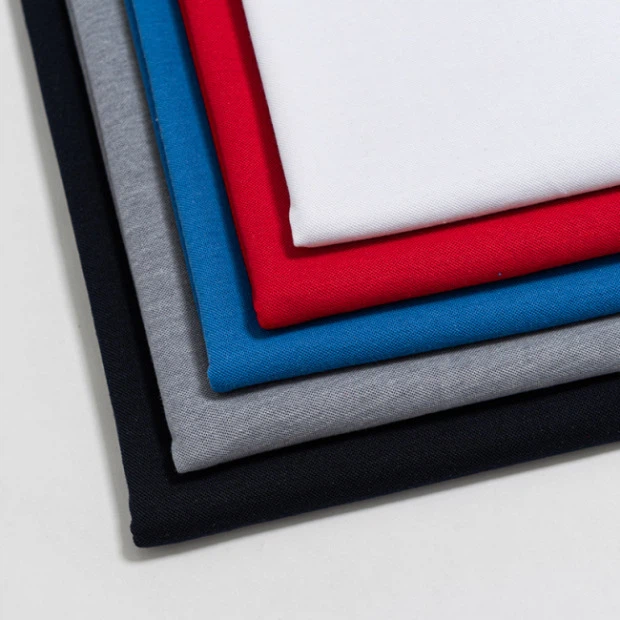


Jersey Knit Fabric:
There is no loom involved in the production of jersey fabric. Knitted fabrics are formed by intertwining a single yarn with needles, hooks, or knitting machines in a single row. A number of basic stitches are used in weft knitting in which all the loops formed in the knitting are identical.
Purl Knit Fabric:
An interweaved fabric of purl and knit stitches is called a purl knit fabric. As the stitches alternate between knitting and purling, the purl knit process is known as purl knitting. It has a reversible design, with identical front and back sides. Neither does the fabric curl nor does it lie flat.
Rib Knit Fabric:
Two needles are used to create rib knit fabric that has vertical textured lines. In weft knitting, the basic stitch is two pairs of hands operating at right angles from each other. Compared to other knits, rib knits are highly elastic in the crosswise direction.
French Terry Knit Fabric:
The French Terry knit fabric has loops on one side that are heaped on the other. Its softness and plushness make it a common material to use in producing robes. Fabrics made from Terry Knitted fabric use a special attachment in regular circular knitting machines to create piled jersey fabrics.
Fleece Knit Fabric:
Loungewear and casual clothing like sweatshirts and sweatpants are also often made from fleece fabric, often called sweatshirt fleece. In the same way, French terry fabric fleece has loops of yarn on the back side, which are used to line the inside of garments.
Double Knit Fabric:
Double-needle knitted fabrics (such as wool) that have two thicknesses joined with interlocking stitches that give them a double thickness.
Cable Knit Fabric:
Fabrics made from cable knit are double knit materials made by special loop transfer techniques. Plaits are formed by transferring loops between adjacent Wales in the fabric, giving it a rope-like appearance. The fabric loops cross each other to produce a surface texture that looks like braiding.
Interlock Knit Fabric:
Interlock fabrics are another type of weft knitted fabric. Two rows of needles are used to manufacture interlock fabrics. Interlock fabric can be used to create a wide range of apparel.
Jacquard Knit Fabric:
Knit fabrics with Jacquard patterns use Jacquard controls on knitting machines that use the Jacquard mechanism for creating intricate designs.
Needles. First of all, you will need a special needle – ballpoint. The problem is that if you use a regular needle, it will make holes in your knit fabric. Double or twin needle will be an ideal choice for sewing with knit fabrics.
Use a Walking Foot. Without this device, the sewing machine pulls only the bottom layer of fabric. The Walking Foot pulls the top layer of fabric with the bottom either.
Cut on a Surface. All the fabrics should be cut on a table or floor, without hanging edges. Remember, knit fabrics have a stretch. With edges hanging you can make a mistake while cutting.
Zig-Zag Stitch. It is highly recommended for knitwear when sewing seams, because a zig-zag stitch stretches along with the fabric, unlike a straight stitch.
Tissue Paper. Use it to connect the edges when sewing them up to prevent the fabric from stretching. Tissue paper is applied underneath the seam (or on the top) when sewing two layers of knit fabric and removed after finishing the process.

Applications of Knit Textile Fabric Across Industries
Sportswear and Activewear
Circular knitting is widely used to produce high-performance sportswear that needs to be breathable, flexible, and durable. Lycra fabric, spandex fibers, and jersey fabric are commonly used in sportswear to provide stretch, comfort, and moisture-wicking properties.
Medical Textiles
Circular knitted textiles are a staple in the medical industry, where they are used to create products such as compression garments, wound dressings, and even antimicrobial underwear. These fabrics must be breathable, elastic, and offer gentle compression, making circular knitting ideal for producing them.
Automotive Industry
In the automotive industry, circular knitted textiles are used for seat covers, headrests, and airbags. The seamless and durable construction of these fabrics allows them to adapt to the contours of car interiors, providing comfort and long-lasting wear. Textile mills often produce custom fabrics that meet the safety and performance standards required by automotive manufacturers.
Protective Clothing and Industrial Textiles
Circular knitted technical textiles are key in producing protective garments, such as fire-resistant uniforms, bulletproof vests, and water-resistant fabrics for harsh environments. The strength, flexibility, and seamless construction of these textiles make them perfect for industrial use.
Outdoor Fabrics
Circular knitted textiles are essential for outdoor applications. Outdoor fabrics like water-resistant fabric are used in tents, awnings, and protective coverings, while more breathable materials like French terry are ideal for activewear and loungewear.
FAQ
We're professional knitted fabric manufacturers and suppliers in China, specialized in providing quality products and fast delivery. Please feel free to wholesale high-end knitted fabric from our factory. Contact us for customized service and free sample.